
Bayesian retrieval of exoplanet reflected-light and thermal emission spectra
ExoReL (Exoplanetary Reflected Light Retrieval) is a Bayesian retrieval framework for interpreting reflected-light and thermal emission spectra of directly imaged exoplanets. It was introduced to support high-contrast imaging missions such as Roman, HabEx, and LUVOIR, and to support the development of the Habitable Worlds Observatory. It retrieves atmospheric structure and cloud properties from reflected-light and thermal emission spectra using a physically consistent treatment of clouds and gas mixing ratios.
Project repository: github.com/MDamiano/ExoReL.
Why reflected-light retrieval is difficult
Direct imaging gives us the planet-star contrast ratio as a function of wavelength. That is an extraordinarily rich observable, but it is not a direct measurement of an atmospheric composition. The spectrum depends on the stellar flux, the planet radius, orbital phase, gravity, clouds, surface reflectance, gas absorption, Rayleigh scattering, and the vertical pressure levels from which photons escape. Many of those quantities can move the spectrum in similar ways. A retrieval code is useful only if it keeps those degeneracies explicit rather than hiding them.
ExoReL does that by joining a radiative-transfer forward model to Bayesian sampling. For each proposed atmosphere, the code computes a reflected-light or thermal-emission spectrum, compares it with the data, and lets nested sampling map the posterior probability distribution of the physical parameters. The output is not a single best atmosphere. It is the family of atmospheres that are statistically allowed by the measurement.
A physically linked cloud model
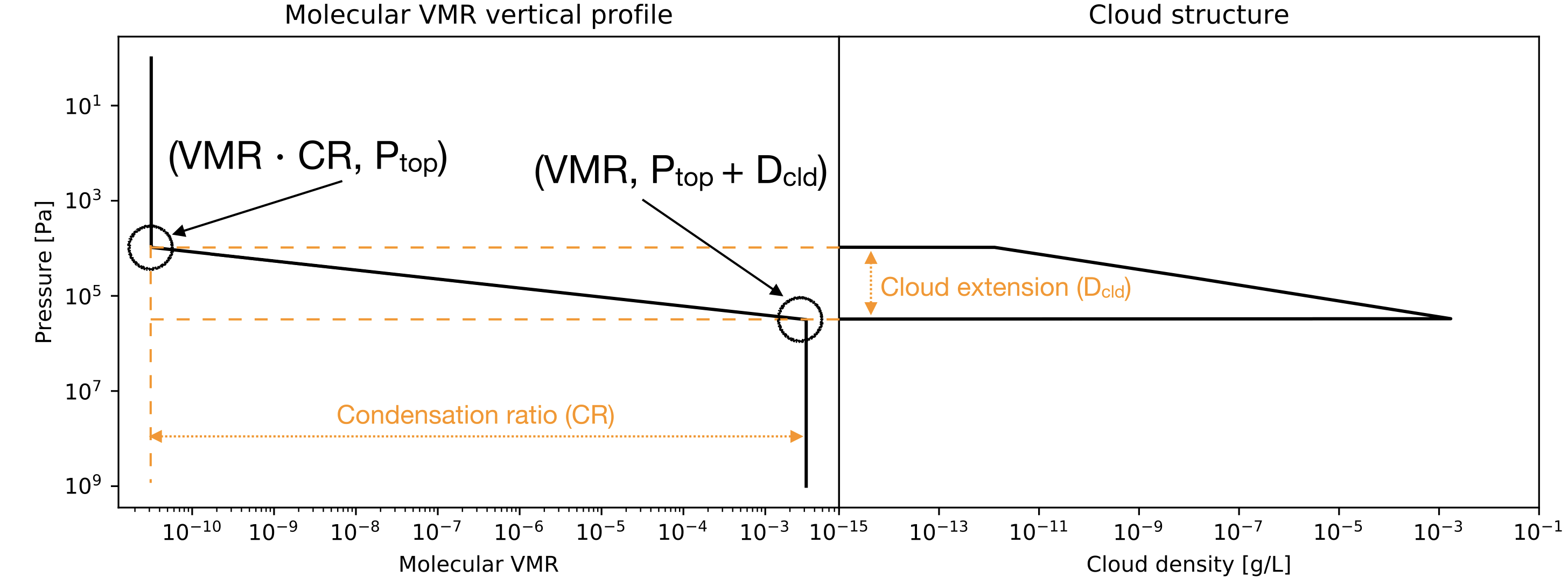
One of ExoReL’s most important design choices is that cloud structure is not treated as an arbitrary opacity screen. In the original reflected-light implementation, condensing species such as H2O and NH3 are allowed to have vertically non-uniform volume mixing ratio profiles. A cloud deck is then constructed from that profile using a cloud-top pressure, cloud extension, and condensation ratio. This makes the retrieved cloud chemically meaningful: a water cloud is linked to the retrieved water profile, an ammonia cloud to the ammonia profile, and so on.
That coupling matters because reflected-light photons often do not probe the deep atmosphere directly. If a cloud truncates the observable column, a retrieval that treats the cloud independently of chemistry may fit the spectrum while losing the physical connection to the gas reservoir below it. ExoReL was built to keep that connection in the inference.
From spectra to posteriors
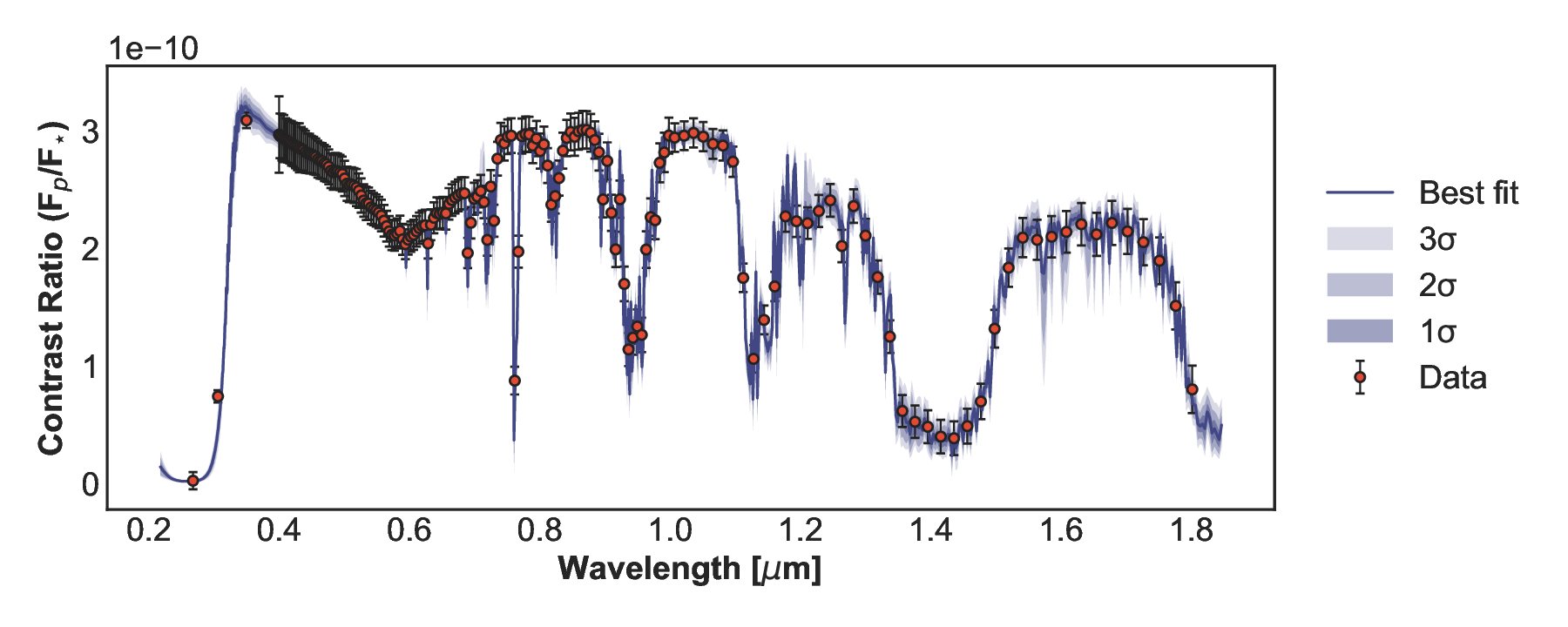
The first diagnostic is the spectral fit. ExoReL compares the measured contrast ratio with the ensemble of forward models sampled by the retrieval. The best-fit model is only the center of the story; the shaded credible regions show how much model freedom remains after the data have been used.
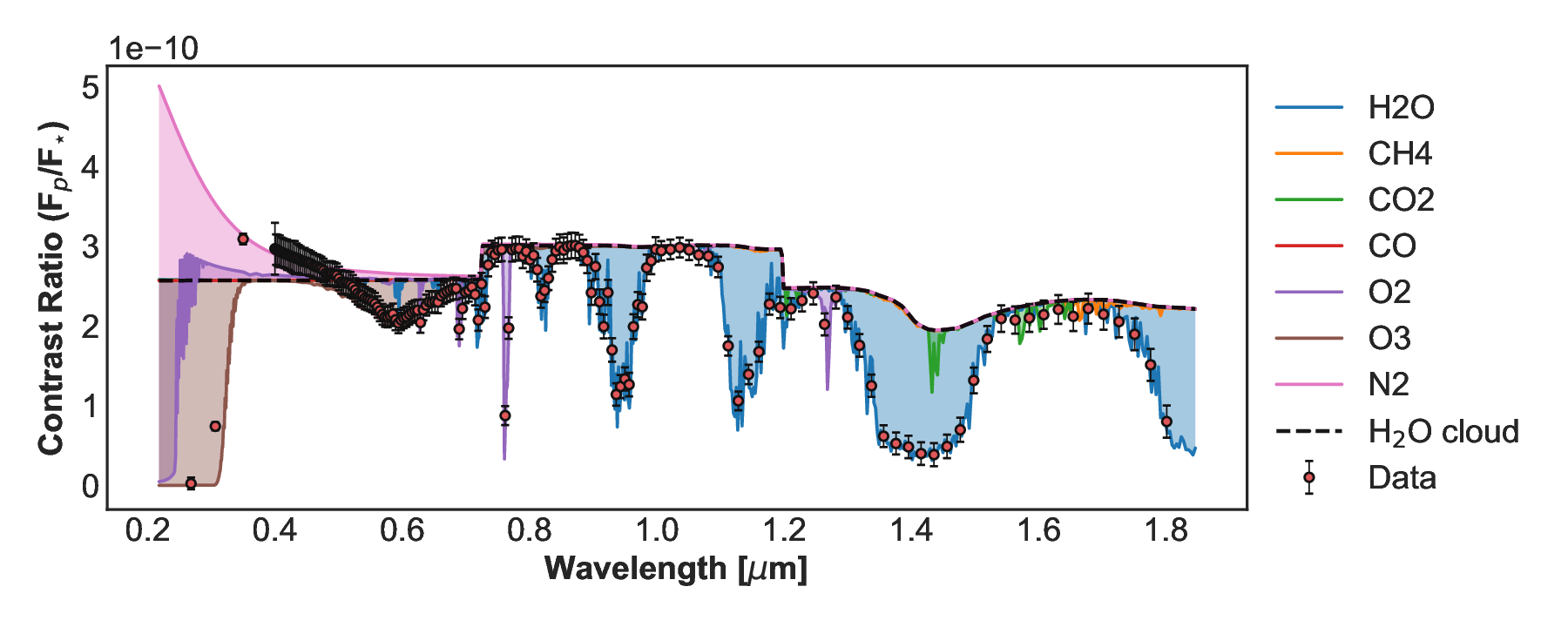
The molecular contribution plot asks a different question: which opacity sources shape which parts of the spectrum? In reflected light, the visible and near-infrared bands are not interchangeable. O3, O2, H2O, CH4, CO2, clouds, and surface reflection all leave signatures in different wavelength regions. This is why ExoReL has been used not only to interpret spectra, but also to test observing strategies for Roman-like, HabEx-like, LUVOIR-like, and Habitable Worlds Observatory concepts.
Atmospheric structure, not just abundances
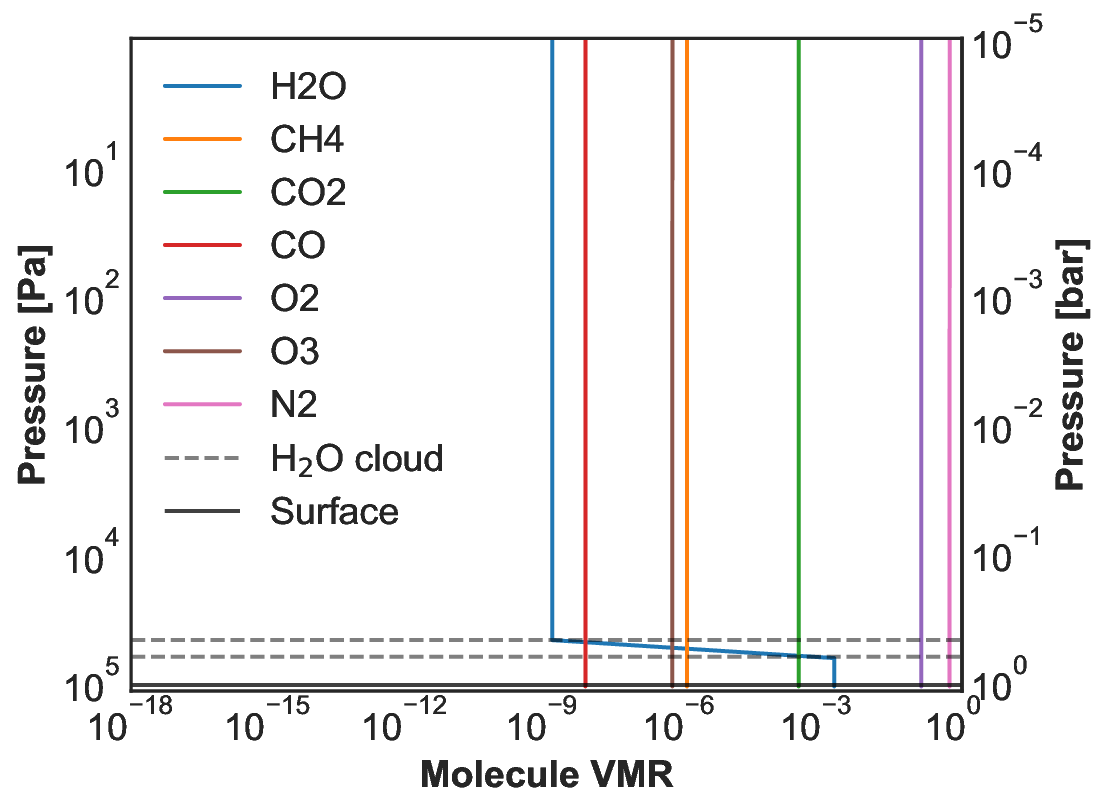
A retrieval of a directly imaged planet must recover more than a list of molecular abundances. The vertical location of the absorbing gas, the pressure of the scattering cloud, and the surface pressure all affect the observed contrast. ExoReL reports these quantities in pressure space, where the radiative-transfer problem is physically posed.
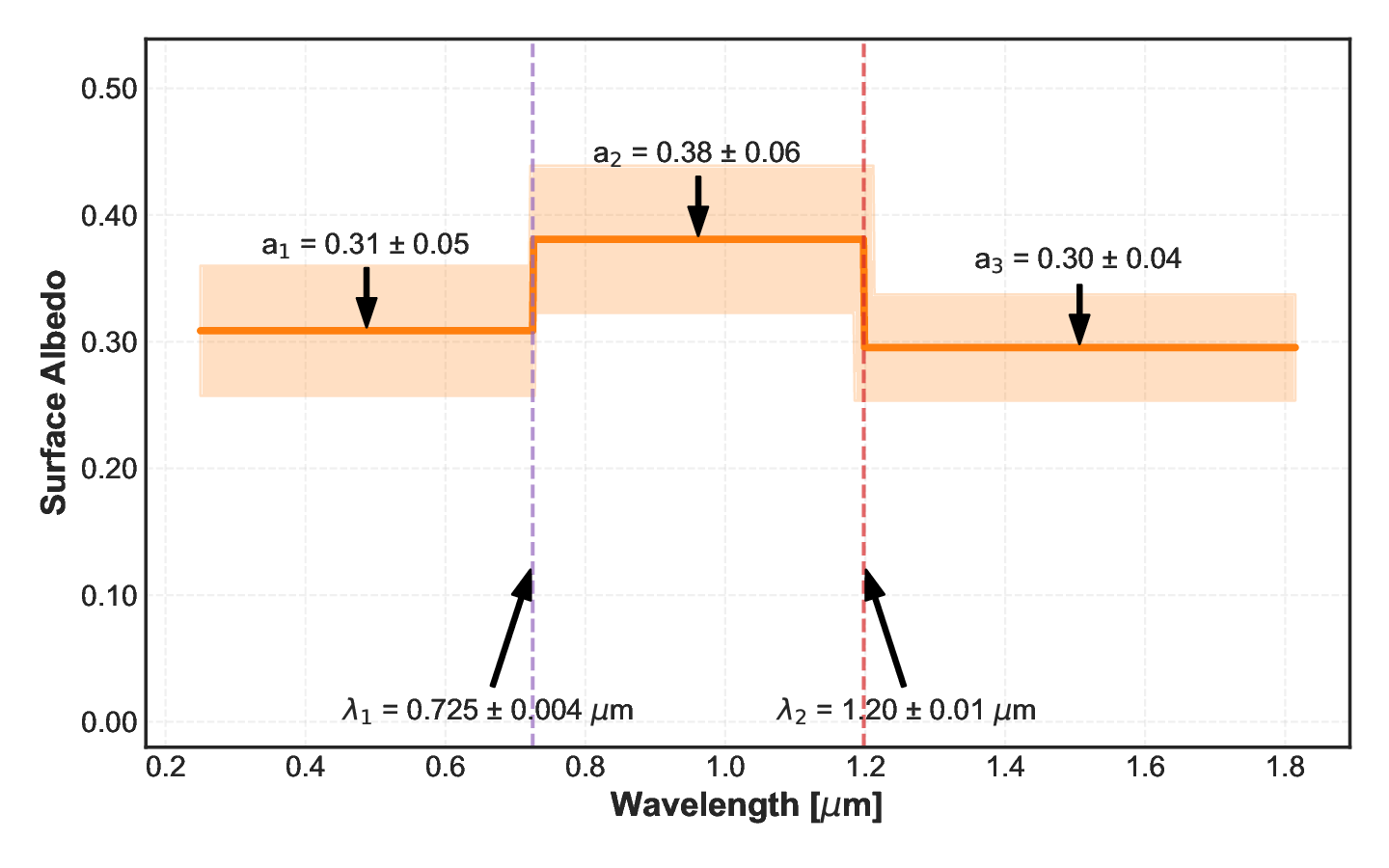
For terrestrial planets, ExoReL can also retrieve a wavelength-dependent surface albedo. This is important because a rocky planet’s reflected spectrum is not produced by the atmosphere alone. The surface can brighten or dim broad wavelength intervals, alter the apparent depth of gas bands, and produce false confidence if it is forced into an over-simple form. A flexible surface model lets the retrieval separate atmospheric absorption from continuum reflectance as far as the data allow.
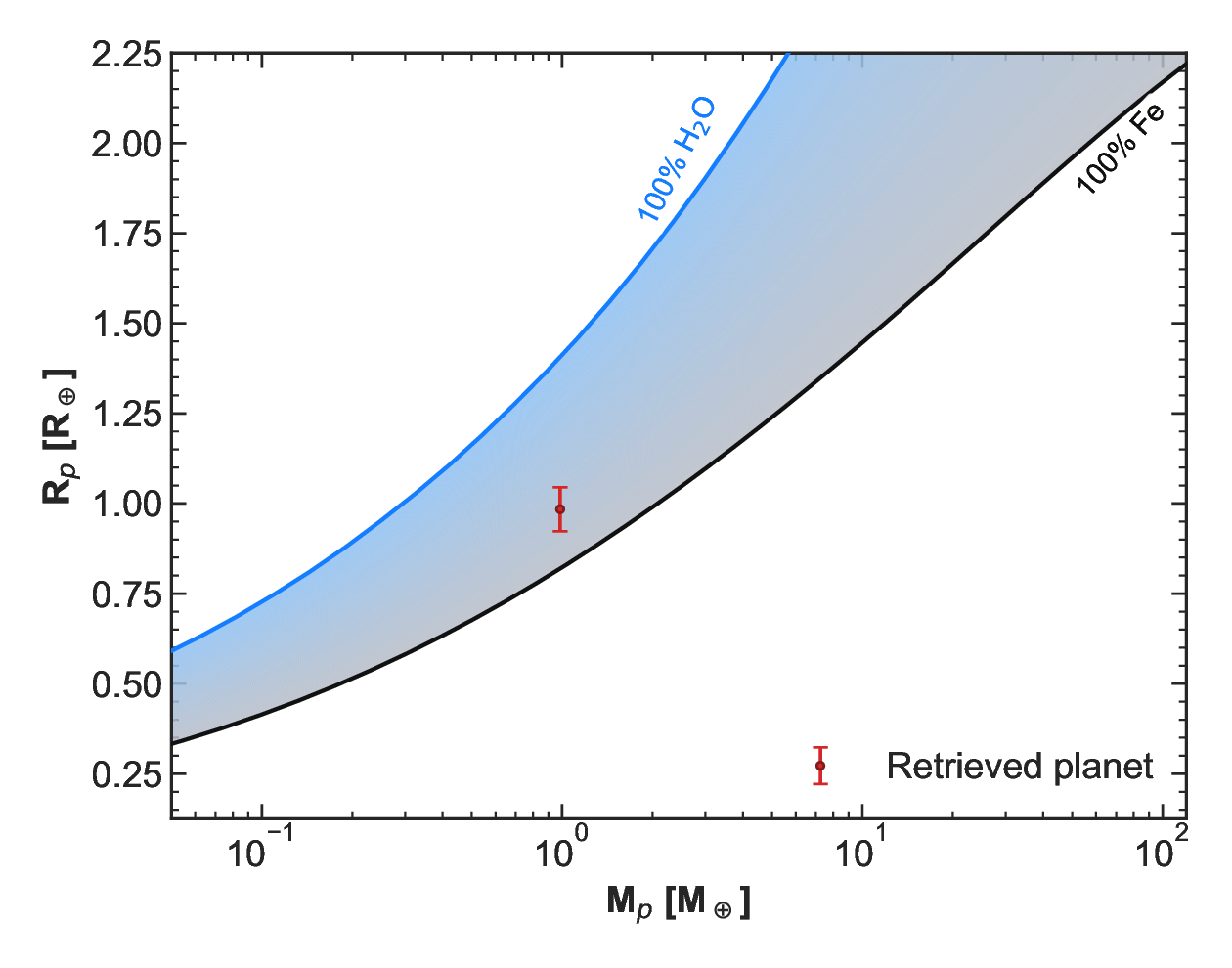
Planetary bulk properties enter the problem as well. Radius sets the planet-star contrast normalization, mass affects gravity and atmospheric scale height, and both influence the physical interpretation of the retrieved atmosphere. ExoReL’s outputs can therefore be placed against mass-radius composition curves to check whether the inferred planet is consistent with a rocky, water-rich, or volatile-dominated interior.
Reading the posterior
The posterior distributions are the heart of the retrieval. They show what the data know, what the priors still control, and which parameters are correlated. Some quantities may be sharply constrained, such as surface-albedo breaks or strong molecular features. Others may remain bounded only from one side. That information is scientifically useful: it tells us whether a spectrum supports a robust detection, a meaningful upper limit, or a family of degenerate atmospheric scenarios.
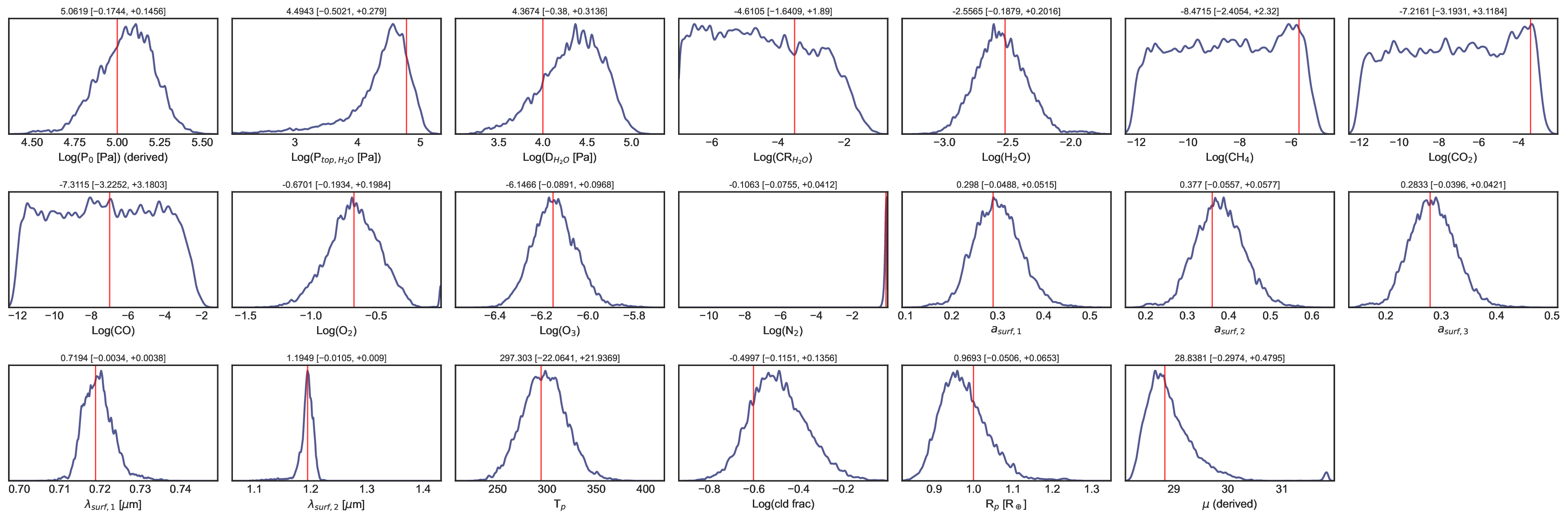
This is the central reason ExoReL is useful for mission design. In reflected-light spectroscopy, adding a second wavelength band, observing a second orbital phase, or extending into the near-UV can change the answer qualitatively. Previous ExoReL studies showed that limited wavelength coverage can admit plausible but wrong cloud-gas solutions, while additional bands or phases can break those degeneracies. For terrestrial planets, the same framework has been used to ask which combinations of O2, O3, H2O, CO2, CH4, CO, N2O, cloud structure, mass, radius, and surface reflectance are recoverable from future direct imaging spectra.
What the code provides
The public ExoReL repository includes tools to generate reflected-light and thermal-emission spectra, create synthetic datasets with noise and error bars, run MultiNest-based Bayesian retrievals, and automatically produce the standard diagnostic plots shown above. The code is therefore useful both as a retrieval engine and as a simulation laboratory: it can analyze a measured spectrum, test whether a planned observation can recover a target molecule, and expose the wavelength ranges where the physics is underconstrained.
References
- Damiano, M., Hu, R. (2020). “ExoReLR: a Bayesian inverse retrieval framework for exoplanetary reflected light spectra.” AJ, 159, 175.
- Damiano, M., Hu, R., Hildebrandt, S. R. (2020). “Multi-orbital-phase and multi-band characterization of exoplanetary atmospheres with reflected light spectra.” AJ, 160, 206.
- Damiano, M., Hu, R. (2021). “Reflected spectroscopy of small exoplanets I: determining the atmospheric composition of sub-Neptunes planets.” AJ, 162, 200.
- Damiano, M., Hu, R. (2022). “Reflected spectroscopy of small exoplanets II: characterization of terrestrial exoplanets.” AJ, 163, 299.
- Damiano, M., Hu, R., Mennesson, B. (2023). “Reflected spectroscopy of small exoplanets III: probing the UV band to measure biosignature gasses.” AJ, 166, 157.
- Damiano, M., Burr, Z., Hu, R., Burt, J., Kataria, T. (2025). “Effects of planetary mass uncertainties on the interpretation of the reflectance spectra of Earth-like exoplanets.” AJ, 169, 97.
- Burr, Z., Damiano, M., Kofman, V., Hu, R., Villanueva, G. L. (2026). “Retrieving the Red Edge on Earth-like Planets with Heterogeneous Clouds and Surfaces.” ApJ, 1001, 222.

Mario Damiano
Ph.D. in Astrophysics